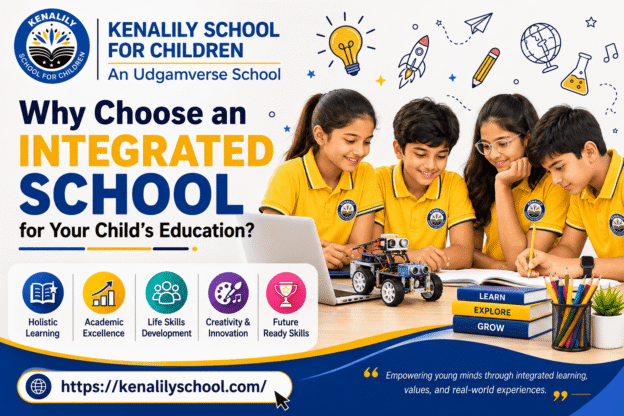
Choosing the right educational environment can significantly influence a child’s academic progress, confidence, interests, and overall development. Many parents today are looking beyond conventional classroom teaching and exploring learning models that connect academics with practical skills, activities, and personal growth. A Best integrated school in Ahmedabad may offer an approach where different aspects of education are thoughtfully connected, helping learners develop knowledge while also preparing for real-world challenges. Instead of focusing exclusively on examination performance, this model can encourage curiosity, creativity, collaboration, communication, and independent thinking.
An integrated learning environment typically brings together multiple educational experiences within a coordinated framework. Depending on the institution, students may receive opportunities to participate in academics, sports, arts, technology, life-skills activities, projects, and other enrichment programs. This broader approach can make education more meaningful because children are encouraged to understand how classroom concepts relate to situations beyond textbooks.
How an Integrated Learning Environment Supports Children
One of the major advantages of this educational model is its emphasis on holistic development. Children have different strengths, interests, learning speeds, and personalities. A flexible environment can provide opportunities for them to discover these qualities rather than measuring their abilities through academics alone.
Parents researching an Integrated school in Ahmedabad should consider how the institution approaches curriculum delivery, student participation, skill development, teacher interaction, and co-curricular opportunities. The objective should not simply be to provide more activities but to create meaningful connections between different areas of learning.
Here are several reasons why this approach can be valuable:
- Holistic development: Academic learning can be combined with physical, creative, social, and emotional development
- Practical learning: Projects, experiments, presentations, and activities can help students connect theoretical concepts with practical situations.
- Better time management: A coordinated educational structure may help children balance studies, activities, recreation, and personal interests.
- Skill development: Communication, teamwork, problem-solving, leadership, and decision-making can be developed alongside subject knowledge.
- Greater engagement: Interactive lessons and activity-based experiences can make children more interested in the learning process.
- Individual interests: Exposure to different disciplines allows students to identify areas they enjoy and potentially develop further.
- Collaborative learning: Group activities can teach students how to communicate respectfully, share responsibilities, and work toward common objectives.
- Future readiness: Modern education increasingly requires adaptability, digital awareness, creativity, and critical thinking, in addition to strong academic foundations.
A Balanced Approach to Academics and Activities
A common misconception is that an integrated educational model means reducing academic focus. In reality, the objective is usually to create connections between academic knowledge and other forms of learning. Strong subject foundations remain important, but students may also be encouraged to understand, apply, question, and discuss what they learn.
For example, a science lesson could be supported through experiments, environmental projects, demonstrations, or technology-based activities. Mathematics can be connected with everyday problem-solving, budgeting exercises, measurements, or logical games.
Language learning can extend beyond written examinations through discussions, presentations, storytelling, and creative writing.
Such experiences can help students understand that education is not limited to memorizing information. Knowledge becomes more valuable when learners can apply it in different contexts.
Encouraging Confidence and Independence
Children need opportunities to make decisions, express opinions, solve problems, and learn from mistakes. An educational environment that encourages participation can gradually strengthen confidence.
Presentations, group assignments, competitions, creative activities, and classroom discussions can provide students with opportunities to communicate their ideas. Teachers can guide learners while allowing them enough independence to explore solutions.
This can also help children become more comfortable with challenges. Instead of viewing mistakes only as failures, they can learn to treat them as opportunities to improve. Such an attitude can become valuable throughout higher education and professional life.
Preparing Students for a Changing Future
The expectations placed on young people are changing rapidly. Academic qualifications remain important, but employers and higher education institutions also value skills such as communication, collaboration, creativity, adaptability, analytical thinking, and responsible decision-making.
An educational framework that introduces children to different forms of learning can help build these capabilities gradually. Technology, project-based assignments, teamwork, research activities, and creative expression can complement conventional lessons and give learners a broader foundation.
However, parents should avoid choosing an institution solely because it offers a long list of activities. Quality matters more than quantity. Families should examine whether activities are thoughtfully connected to learning objectives and whether students receive appropriate guidance.
What Parents Should Consider Before Making a Choice
When comparing educational institutions, parents should look beyond infrastructure and promotional claims. The teaching philosophy, curriculum, teacher experience, student support, safety standards, classroom environment, and communication with families can all influence the quality of a child’s experience.
Parents searching for an Integrated school near me can begin by preparing a practical checklist and visiting potential institutions where possible. Speaking with teachers and understanding how the learning model operates on an everyday basis can provide useful insights.
Consider factors such as:
- Curriculum structure and academic standards
- Teacher-to-student interaction
- Co-curricular and extracurricular opportunities
- Sports, arts, technology, and creative learning
- Student wellbeing and pastoral support
- Assessment methods and feedback systems
- Communication between parents and educators
- Opportunities for projects and experiential learning
- Accessibility and daily commute
- Overall learning environment and values
The right choice ultimately depends on the child’s individual needs, interests, learning style, and long-term educational goals. What works well for one learner may not necessarily suit another.
Conclusion
An integrated approach can offer children a broader educational experience by connecting academic knowledge with practical experiences, creativity, collaboration, physical activity, and personal development. It can help learners build not only subject knowledge but also the confidence and skills needed to navigate future opportunities.
Parents should make their decision carefully by understanding the institution’s educational philosophy, observing its learning environment, and considering whether its approach matches their child’s needs. Rather than selecting an institution based only on popularity or promotional claims, families can focus on teaching quality, student support, meaningful learning opportunities, and long-term development. Whether considering an ahmedabad international school or another educational model, the goal should remain the same: creating a supportive environment where children can learn, explore, grow, and become capable, responsible individuals.
Faqs
What are the benefits of an integrated education approach?
It can support academic understanding while developing creativity, communication, teamwork, critical thinking, confidence, and problem-solving abilities.
How does integrated learning differ from traditional education?
Traditional education may focus primarily on subject-based instruction, while an integrated approach connects academic concepts with practical activities and skills.
How should parents choose an integrated school?
Parents should consider curriculum quality, teaching methods, student support, safety, extracurricular opportunities, learning facilities, teacher interaction, and the child’s individual needs.
Is integrated education suitable for every child?
It can benefit many learners, but parents should consider their child’s learning style, interests, academic requirements, personality, and long-term goals before making a decision.