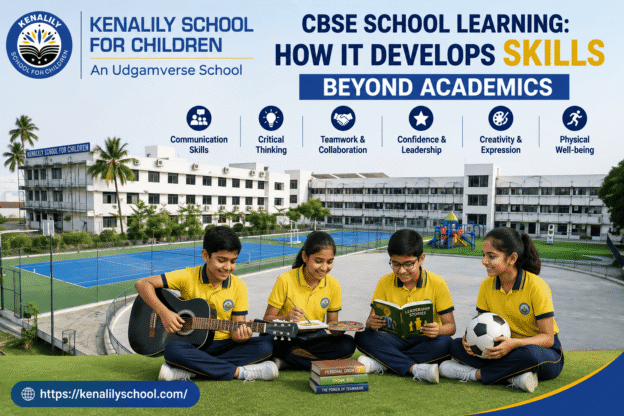

Education is no longer limited to textbooks, examinations, and memorising information. A well-rounded learning environment helps children develop communication, creativity, critical thinking, teamwork, leadership, confidence, and problem-solving abilities. These skills can influence how students handle challenges in school and later in higher education and professional life. For parents exploring the Best CBSE School In Ahmedabad, it is important to understand how classroom learning can support development beyond marks and grades. A strong educational approach combines subject knowledge with practical experiences that encourage children to ask questions, explore ideas, collaborate with others, and apply what they learn to real-life situations.
CBSE learning can develop skills beyond academics through projects, experiments, sports, arts, technology, discussions, presentations, and collaborative activities. These experiences encourage students to think independently, communicate effectively, solve problems, manage responsibilities, and connect classroom concepts with practical situations.
How Does Learning Beyond Academics Benefit Students?
Academic knowledge gives students an important foundation, but children also need transferable skills to use that knowledge effectively. A student may understand a scientific concept but still need communication and teamwork skills to explain it or complete a group project successfully.
A balanced educational experience can help students develop:
- Communication: Expressing ideas clearly through speaking, writing, and presentations.
- Critical thinking: Examining information and making logical decisions.
- Creativity: Developing original ideas and exploring different solutions.
- Teamwork: Cooperating with classmates and respecting different perspectives.
- Problem-solving: Applying knowledge to unfamiliar situations.
- Leadership: Taking initiative and accepting responsibility.
- Self-management: Organising time, tasks, and learning responsibilities.
These capabilities are valuable because they can be applied across subjects and everyday situations.
Why Is Experiential Learning Important?
Experiential learning allows students to understand concepts through activities, observation, experimentation, and practical application. Instead of simply reading about a topic, learners can investigate questions and discover how concepts work in real situations.
For example, an environmental project could ask students to examine waste generated at school. They might collect information, classify materials, calculate quantities, research recycling methods, and present their recommendations.
Such an activity can develop several abilities simultaneously:
Research: Students learn to locate and evaluate relevant information.
Analysis: They interpret observations and identify patterns.
Collaboration: Team members divide tasks and work together.
Communication: Findings are shared through presentations or reports.
Problem-solving: Students suggest practical improvements.
This approach makes learning more meaningful because children understand how knowledge can be applied outside a textbook.
How Do Projects Encourage Independent Thinking?
Projects give students opportunities to make choices rather than simply follow predetermined answers. Depending on their age, learners may decide how to collect information, organise findings, design a presentation, or solve a particular challenge.
Teache
rs remain important throughout this process. Their role is to provide guidance, ask questions, explain difficult concepts, and give constructive feedback.
Parents researching educational options can also examine a List Of CBSE Schools In Ahmedabad to compare teaching methods, project opportunities, student participation, and extracurricular programmes. However, the number of activities should not be the only consideration. Their educational purpose and quality matter more.
How Do Sports and Arts Build Life Skills?
Sports and creative activities provide learning opportunities that are different from traditional classroom lessons.
Team sports can encourage discipline, cooperation, perseverance, respect for rules, and resilience. Students experience both success and disappointment, helping them understand how to respond constructively to different outcomes.
Arts can support imagination, self-expression, confidence, and attention to detail. Activities such as theatre, music, painting, dance, and creative writing allow children to communicate ideas in different ways.
These experiences can complement academic learning by helping students become more confident and adaptable.
How Does Technology Support Skill Development?
Technology can become a powerful learning tool when it is used for investigation and creation rather than passive consumption.
Students may use digital tools to:
- research informationcreate presentations
- analyse data;
- develop simple programmes;
- design digital projects;
- collaborate on assignments;
- explore simulations and educational resources.
Technology-related learning can also introduce students to responsible digital behaviour. They need to understand information reliability, online safety, privacy, ethical technology use, and appropriate communication.
CBSE has increasingly incorporated areas such as artificial intelligence, coding, robotics, STEM education, and computational thinking into its educational resources. The emphasis should remain on meaningful learning rather than using technology simply because it is available.
How Can Parents Evaluate Skill-Based Learning?
Searching for a CBSE School In Ahmedabad Near Me may help families identify convenient options, but location should be only one part of the decision.
Parents can evaluate a school using these questions:
- Does the teaching approach encourage students to ask questions?
- Are practical projects connected to classroom concepts?
- Do children receive opportunities to present their work?
- Are sports and creative activities integrated into student development?
- How does the school support communication and teamwork?
- Are students encouraged to solve problems independently?
- Does assessment measure understanding and application as well as recall?
Parents should also review the school’s official affiliation information, curriculum, learning environment, teacher development practices, safety provisions, and student-support systems.
Academic Learning vs Skill-Based Development
| Factor | Traditional Focus | Broader Learning Approach |
|---|---|---|
| Main emphasis | Subject knowledge | Knowledge plus practical application |
| Classroom role | Teacher-led instruction | Active student participation |
| Projects | Occasional assignments | Purposeful learning experiences |
| Communication | Written answers | Discussions, presentations, and writing |
| Problem-solving | Familiar questions | Real-world and unfamiliar challenges |
| Creativity | Limited opportunities | Encouraged through varied activities |
| Assessment | Mainly examinations | Multiple ways to demonstrate understanding |
The two approaches do not need to compete. Strong academic foundations remain essential, while practical experiences help students understand how to use what they learn.
What Should Parents Look for in a Future-Ready Learning Environment?
A quality learning environment should provide opportunities for children to gradually develop academic knowledge and personal capabilities.
Parents should consider:
- Curriculum: Is the academic foundation structured and age-appropriate?
- Teaching: Are teachers encouraging curiosity and reasoning?
- Activities: Do projects have meaningful learning objectives?
- Communication: Can students express and defend their ideas?
- Collaboration: Are children given opportunities to work with others?
- Well-being: Does the environment support balanced development?
- Feedback: Are students encouraged to learn from mistakes?
- Responsibility: Do learners receive age-appropriate ownership of tasks?
The goal is not to keep children busy with numerous activities. It is to create experiences where every activity has a meaningful developmental purpose.
Common Mistakes Parents Should Avoid
One common mistake is judging an institution entirely by examination scores. Academic performance is important, but it does not provide a complete picture of a child’s educational experience.
Parents should also avoid selecting a school based only on:
- the number of extracurricular activities;
- impressive infrastructure;
- promotional claims;
- rankings without context;
- proximity to home.
Instead, families should investigate how students actually learn, participate, communicate, collaborate, and receive feedback.
Key Takeaways
- Learning should develop academic knowledge as well as practical abilities.
- Projects can strengthen research, teamwork, communication, and problem-solving.
- Sports and arts support confidence, discipline, creativity, and resilience.
- Technology can encourage research, digital literacy, innovation, and responsible use.
- Parents should evaluate teaching practices rather than relying on promotional claims.
- A balanced environment gives students opportunities to apply knowledge in meaningful situations.
Conclusion
A meaningful school experience should prepare children not only to answer examination questions but also to understand problems, communicate ideas, collaborate with others, and make thoughtful decisions. Projects, practical activities, technology, sports, arts, discussions, and presentations can turn everyday learning into opportunities for broader development.
When comparing CBSE Schools In Ahmedabad, parents should therefore look beyond marks and visible facilities. The more important consideration is whether students receive consistent opportunities to apply knowledge, explore ideas, build confidence, and develop skills for real-world situations.
Parents can also explore Kenalily School to understand its educational approach, learning environment, curriculum, and opportunities for student development. Reviewing these factors carefully can help families make a more informed and child-focused educational decision.
Faqs
Why are extracurricular activities important for children?
Extracurricular activities provide experiences that complement classroom learning. Sports can encourage discipline and teamwork, while arts can support creativity and expression. Clubs, competitions, debates, and cultural activities can also give students opportunities to develop confidence, communication, leadership, and organisational abilities in situations that may differ from regular lessons.
What should parents consider when choosing a school?
Parents should consider curriculum quality, teaching methods, teacher support, student participation, assessment practices, extracurricular opportunities, safety, infrastructure, communication with families, and the overall learning environment. It is useful to visit the school, ask specific questions, and understand how activities contribute to children's development rather than choosing solely on reputation or convenience.
Can project-based learning improve problem-solving?
Yes. Well-designed projects can require students to investigate a question, gather information, compare options, make decisions, and present a solution. This process can strengthen analytical thinking and encourage learners to approach unfamiliar challenges. Projects become particularly valuable when students are allowed to explain their reasoning and reflect on what they learned.
Why is holistic development important in school education?
Holistic development helps children build capabilities that complement academic knowledge. Communication, creativity, collaboration, critical thinking, resilience, and self-management can support students throughout higher education and later professional life. Developing these abilities gradually can help young learners become more independent and better prepared to respond to changing circumstances.