
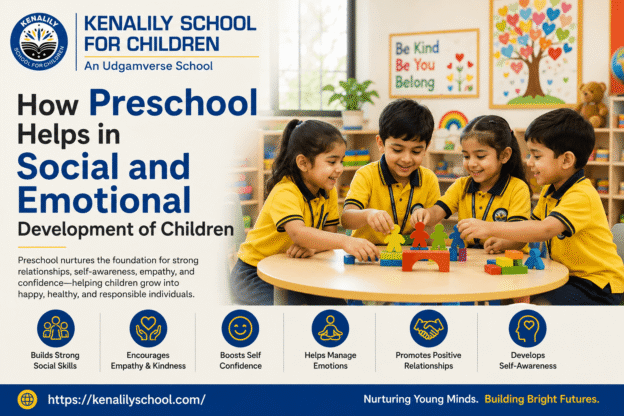
 Preschool is more than an early academic setting. It is often a child’s first structured opportunity to interact regularly with peers, follow routines, communicate with adults outside the family, and manage emotions in a group environment. These experiences can influence how children develop confidence, empathy, independence, cooperation, and emotional awareness.
For parents researching the Best Preschool In Ahmedabad, understanding social and emotional development is just as important as considering curriculum, infrastructure, teaching methods, and safety. A well-planned early-learning environment gives children opportunities to practise everyday social skills rather than simply learning about them.
This article explains how preschool contributes to emotional growth, what parents should look for, how teachers support children through challenging situations, and which practical factors can help families evaluate an early-years programme.
Preschool supports social and emotional development by giving children regular opportunities to communicate, cooperate, share, solve small conflicts, express feelings, follow routines, and build relationships. Supportive educators create safe environments where children gradually develop confidence, empathy, self-regulation, independence, and positive approaches to interacting with others.
What Is Social and Emotional Development in Early Childhood?
Social and emotional development refers to how children understand their feelings, respond to emotions, build relationships, communicate with others, and manage behaviour in different situations.
During the preschool years, children are learning that their feelings are valid while also discovering that other people have feelings, needs, and boundaries. They begin moving from primarily family-based interactions toward broader social experiences.
Important areas include:
Emotional awareness: recognising and expressing feelings such as happiness, sadness, anger, fear, or frustration.
Self-regulation: gradually learning to pause, wait, cope with disappointment, and adjust behaviour.
Social interaction: learning to participate in conversations, group activities, games, and cooperative tasks.
Empathy: beginning to recognise how another person may feel.
Independence: making simple choices and completing age-appropriate tasks.
Confidence: developing the willingness to participate, communicate, and try unfamiliar activities.
These abilities do not develop instantly. They are built through repeated experiences, guidance, encouragement, and age-appropriate expectations.
Why Does Preschool Matter for Emotional Growth?
A preschool classroom introduces a predictable social environment where children encounter situations that naturally require emotional and interpersonal skills.
For example, two children may want the same toy. Instead of immediately solving the situation for them, an educator can help them identify the problem, express their needs, listen to each other, and find an acceptable solution.
Such ordinary moments can become meaningful learning experiences.
Children may also practise:
- Waiting for their turn during group activities.
- Asking for help when something feels difficult.
- Recovering after making a mistake.
- Joining a new activity despite initial hesitation.
- Listening while another child speaks.
The objective is not to expect preschoolers to behave like adults. Young children still need considerable guidance. The goal is to help them gradually develop skills they can use independently as they mature.
How Do Teachers Build Social Skills in Preschool?
Educators influence social development through classroom routines, communication styles, activities, and responses to children’s behaviour.
A supportive teacher does not simply tell a child to “behave.” Instead, the educator can help the child understand what happened and identify a more appropriate response.
For instance, if a child pushes another child after becoming frustrated, the teacher can acknowledge the emotion while setting a clear boundary: feeling angry is acceptable, but hurting someone is not. The child can then be guided toward alternatives such as using words, asking for assistance, or taking a brief calming break.
Group activities are particularly valuable because they encourage cooperation. Storytelling, music, role-play, collaborative art, pretend play, and simple games allow children to communicate while working toward shared goals.
Parents considering a play school in ahmedabad can therefore look beyond classroom appearance and ask how educators actually handle peer interactions, disagreements, shyness, separation anxiety, and emotional outbursts.
What Role Do Play and Classroom Activities Have?
Play is a natural way for young children to explore social relationships and emotions.
Pretend play, for example, allows children to take different roles and experiment with perspectives. A child pretending to be a doctor may practise caring language, while another pretending to be a shopkeeper may practise communication and turn-taking.
Structured activities can support development in different ways:
- Cooperative games encourage communication and teamwork.
- Storytelling helps children recognise emotions and different perspectives.
- Role-play gives children a safe way to practise social situations.
- Art activities encourage expression and individual choice.
- Group routines help children understand expectations and predictability.
The strongest programmes generally combine structured learning with age-appropriate opportunities for child-led exploration.
How Does Preschool Help Children Develop Emotional Regulation?
Emotional regulation means gradually learning how to manage feelings and reactions. Preschool cannot eliminate frustration, fear, excitement, or disappointment—and it should not try to. Instead, children need opportunities to experience emotions while learning appropriate ways to respond.
Teachers may use simple strategies such as naming emotions, modelling calm communication, offering choices, using predictable routines, and allowing children time to settle.
A child who says, “I am angry because I cannot use the toy,” is demonstrating a more constructive response than simply grabbing it. The adult can then acknowledge the feeling and guide the child toward a solution.
Parents should remember that emotional regulation develops gradually. Occasional crying, refusal, frustration, or difficulty separating from caregivers can be normal during the early years.
What Should Parents Look for in a Preschool Environment?
When evaluating a Preschool In Ahmedabad gujarat, parents should assess how the environment supports the whole child rather than focusing exclusively on early literacy and numeracy.
Useful questions include:
- How do teachers respond when children disagree?
- Are children encouraged to express feelings respectfully?
- Does the daily routine provide sufficient opportunities for free and guided play?
- How are shy or hesitant children encouraged to participate?
- How does the preschool communicate behavioural concerns with families?
The answers can reveal more about the educational approach than promotional descriptions alone.
Which Preschool Practices Encourage Healthy Social Development?
Several everyday practices can make a meaningful difference.
Consistent routines
Predictable arrival, activity, meal, play, and departure routines can help children understand what comes next. Predictability may make transitions easier and give children a greater sense of security.
Positive communication
Teachers who use clear, respectful language model how children can communicate with others. Instead of relying primarily on punishment, educators can explain expectations and consequences in developmentally appropriate language.
Opportunities for cooperation
Children benefit from activities that require sharing ideas, materials, responsibilities, and space. Cooperative tasks should be realistic for the child’s age rather than demanding advanced social behaviour.
Respect for individual differences
Children develop at different rates. A supportive environment recognises differences in temperament, communication ability, confidence, and adjustment speed without unnecessarily labelling children.
How Can Parents Evaluate a Preschool’s Approach?
A useful evaluation should consider more than fees or proximity. Parents can observe the classroom, speak with educators, understand the daily schedule, and ask how the institution approaches emotional and behavioural development.
| Factor | Limited Support | Stronger Developmental Support |
|---|---|---|
| Social interaction | Mostly individual activities | Regular age-appropriate group interaction |
| Emotional guidance | Behaviour-focused responses | Feelings acknowledged with clear boundaries |
| Play | Mostly unstructured or restricted | Balanced guided and child-led play |
| Communication | Mainly one-way instructions | Conversation and active listening encouraged |
| Family communication | Occasional updates | Consistent, constructive communication |
No single feature determines quality. Parents should consider the overall environment, educator practices, child safety, learning philosophy, and how closely the programme matches their child’s needs.
What Are Common Mistakes Parents Should Avoid?
Parents sometimes evaluate early education primarily through visible academic outcomes. Worksheets, alphabet recognition, numbers, and handwriting can be useful, but they represent only part of early childhood learning.
Another common mistake is expecting immediate social confidence. Some children quickly join group activities, while others need more time to observe before participating.
Parents should also avoid comparing children too closely with classmates or siblings. Development is individual, and social-emotional skills often improve through gradual exposure and consistent support.
Expert Insights: What Should Families Prioritise?
A thoughtful preschool selection process should include educational, developmental, practical, and safety considerations.
Due diligence checklist
- Observe teacher-child interactions during a visit.
- Ask about safeguarding, supervision, hygiene, and emergency procedures.
- Understand the daily routine and balance of guided learning and play.
- Ask how teachers manage conflicts and emotional difficulties.
- Review communication practices between educators and parents.
Families should also understand admission terms, fee structures, transportation arrangements, attendance expectations, and relevant institutional policies before making a decision.
In India, parents may also review whether the institution clearly explains its educational framework and follows applicable child-safety and early-childhood requirements. For formal school education, regulatory considerations can differ from those applying to standalone early-learning centres, so parents should verify the institution’s specific status rather than assuming that every preschool follows the same framework.
How Can Preschool Experiences Continue at Home?
Social-emotional learning becomes stronger when children encounter consistent messages across home and school.
Parents can encourage children to name feelings, listen to others, make simple choices, help with age-appropriate responsibilities, and practise respectful communication.
For example, after a disagreement with a sibling, a parent might ask, “What happened?” followed by “How do you think your sibling felt?” and “What could we do differently next time?”
These questions encourage reflection without turning every incident into a lecture.
Key Takeaways
Preschool plays an important role in creating everyday opportunities for children to practise social and emotional skills. The value lies not only in formal lessons but also in ordinary classroom experiences such as sharing, waiting, communicating, resolving disagreements, making choices, and responding to emotions.
A developmentally appropriate environment should provide predictable routines, supportive adult guidance, meaningful play, opportunities for cooperation, and respectful communication. Parents should evaluate these factors alongside safety, teaching practices, facilities, policies, and practical requirements.
Most importantly, social and emotional development is gradual. Children need patience, consistent expectations, and opportunities to practise skills repeatedly in both educational and home environments.
Conclusion
The preschool years provide an important foundation for relationships, confidence, communication, independence, and emotional awareness. A thoughtfully designed early-learning environment gives children safe opportunities to experience social situations, understand emotions, cooperate with others, and gradually manage their responses.
When parents compare options for the Best Preschool In Ahmedabad, they should therefore consider more than academic activities or infrastructure. The quality of teacher-child relationships, classroom culture, play opportunities, safety practices, family communication, and emotional support can all influence the child’s experience.
Families researching a Top Preschool In Ahmedabad can also explore information provided by [Insert Website Name here] to understand its educational approach, programmes, policies, and learning environment. The final decision should be based on careful observation and the individual needs of the child rather than rankings or promotional claims alone.
Faqs
Can preschool help a shy child become more confident?
A supportive preschool can provide opportunities for a shy child to build confidence gradually. Teachers can avoid forcing participation and instead offer smaller group activities, familiar routines, and encouragement. Over time, positive experiences with classmates and educators may help the child become more comfortable communicating and participating. Every child’s adjustment period is different.
Why is emotional regulation important before primary school?
Emotional regulation helps children respond to frustration, disappointment, excitement, and other strong feelings in increasingly appropriate ways. Before primary school, children benefit from learning how to communicate their needs, wait, follow simple expectations, seek assistance, and recover from setbacks. These abilities can support classroom participation and relationships as educational demands gradually increase.
What activities support social-emotional learning in preschool?
Many everyday preschool activities can support social-emotional growth. Cooperative games encourage teamwork, storytelling introduces different emotions and perspectives, role-play allows children to practise social situations, and group discussions encourage communication. Creative activities can also give children opportunities to make choices and express themselves. The most useful activities are generally age-appropriate, engaging, and supported by responsive adults.
What should parents ask before choosing a preschool?
Parents can ask about teacher qualifications and experience, classroom routines, supervision, safety procedures, teacher-child interaction, conflict management, communication with families, play opportunities, and approaches to emotional development. It is also useful to visit the setting and observe whether children appear engaged, respected, appropriately supervised, and comfortable. Practical factors such as fees, timings, transport, and location should also be considered.